
Nigeria’s banking industry remains one of the most tightly regulated sectors of the economy. Oversight is provided by the Central Bank of Nigeria (CBN), which issues operating licenses to banks based on capital adequacy, governance standards, risk management, and regulatory compliance.
A bank’s license determines how far it can operate, the markets it can serve, and the scale of financial activities it can undertake. With the CBN’s recapitalisation programme reshaping the sector, the question of who is licensed, at what level, and why has become increasingly important.
1. Types of Banking Licences in Nigeria
The CBN categorises commercial banks into three main licence tiers:
International Banking Licence
This is the highest category. It authorises banks to operate both within Nigeria and internationally, including opening subsidiaries and branches abroad and offering cross-border financial services.
• Capital requirement: Historically around ₦500 billion in paid-up capital
• Who it’s for: Large, systemically important banks with global ambitions
National Banking License
This license allows banks to operate across all states in Nigeria but restricts them from establishing full international banking operations.
• Capital requirement: Approximately ₦200 billion in paid-up capital
• Who it’s for: Mid-to-large banks focused primarily on the domestic market
Regional Banking License
Regional license limit banks to operating in selected states or regions rather than nationwide.
• Capital requirement: Significantly lower than national and international banks
• Who it’s for: Smaller banks targeting niche or regional markets
2. Banks with International Banking License (As of Early 2026)
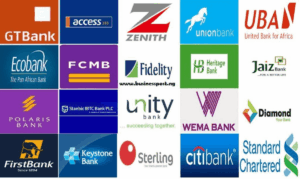
These banks have met the highest regulatory and capital thresholds set by the CBN:
1. Access Bank Plc
2. Fidelity Bank Plc
3. First Bank of Nigeria Ltd
4. Guaranty Trust Bank (GTBank)
5. United Bank for Africa (UBA)
6. Zenith Bank Plc
These institutions dominate Nigeria’s banking landscape and maintain strong footprints across Africa and other global financial centres.
3. Banks with National Banking License
Nationally licensed banks can operate across Nigeria and support both retail and corporate customers:
• First City Monument Bank (FCMB)
• Wema Bank Plc
• Standard Chartered Bank Nigeria
• Citibank Nigeria Limited
• Stanbic IBTC Bank Limited
• Sterling Bank Limited
• Globus Bank Limited
• Premium Trust Bank Plc
Other banks recognised by the CBN under the national category include Ecobank Nigeria, Unity Bank Plc, Keystone Bank Limited, Polaris Bank Limited, Titan Trust Bank, Union Bank of Nigeria, and Optimus Bank.
4. Banks with Regional Banking License
These banks are licensed to operate in limited geographical areas:
• Providus Bank Ltd
• Parallex Bank Ltd
• SunTrust Bank Nigeria Ltd
• Signature Bank Ltd
Regional banks often compete on agility, personalised service, and strong local relationships.
5. Other CBN-Licensed Banking Institutions
Non-Interest (Islamic) Banks
• Jaiz Bank Plc
• TAJ Bank Ltd
Merchant Banks
• Coronation Merchant Bank
• FBN Merchant Bank
• FSDH Merchant Bank
Financial Holding Companies
• Access Holdings Plc
• FBN Holdings Plc
• Guaranty Trust Holding Company Plc
6. The Recapitalisation Drive
In 2024, the CBN launched a recapitalisation exercise aimed at strengthening financial stability, improving risk management, and clearly separating licence categories. Banks are now under pressure to raise capital, merge, or realign their licence ambitions.
7. Why Banking Licences Matter
• Depositor protection: Licensed banks are supervised by the CBN and insured by the Nigeria Deposit Insurance Corporation (NDIC).
• Economic stability: Strongly capitalised banks are better positioned to fund businesses and infrastructure.
• Global integration: International licences enable Nigerian banks to support trade and investment flows.
Bottom Line
A banking licence is not just regulatory approval — it defines a bank’s reach, credibility, and resilience. As recapitalisation reshapes the industry, licence status will increasingly determine which banks lead, consolidate, or fall behind.
Read Also: Nigerians To Pay Higher Fees for Driver’s Licenses and Number Plates from June 8, 2025
Below is how we can help you promote your event, organization and products/services . This is the best you can get from this global platform of over decades experience.
PACKAGE:
First Leg: Full page Promotional package showcasing your Invitation Card, Banner/Flex, 3 different Photographs and brief of the coming event. Also your picture/Name will be the headline News in digivation blog(Pre-Event)
Second Leg: Full Page Promotional package of the event showcasing 5 different photographs plus short audio/visual clip of the event. Also org. picture/Name will be the headline news our blog(Post-Event).
Rate: N150,000 Only For Both Pre and Post Events. (Rate is only Applicable during the Promotional Period)
For further inquiries, contact the undersigned:
Hilary Damissah (Editor)
Mojisola Alabi ( business Development)
Email: digivationtv@gmail.com
Chief Imo Ukwa(Advert Consultant) 08063779938